

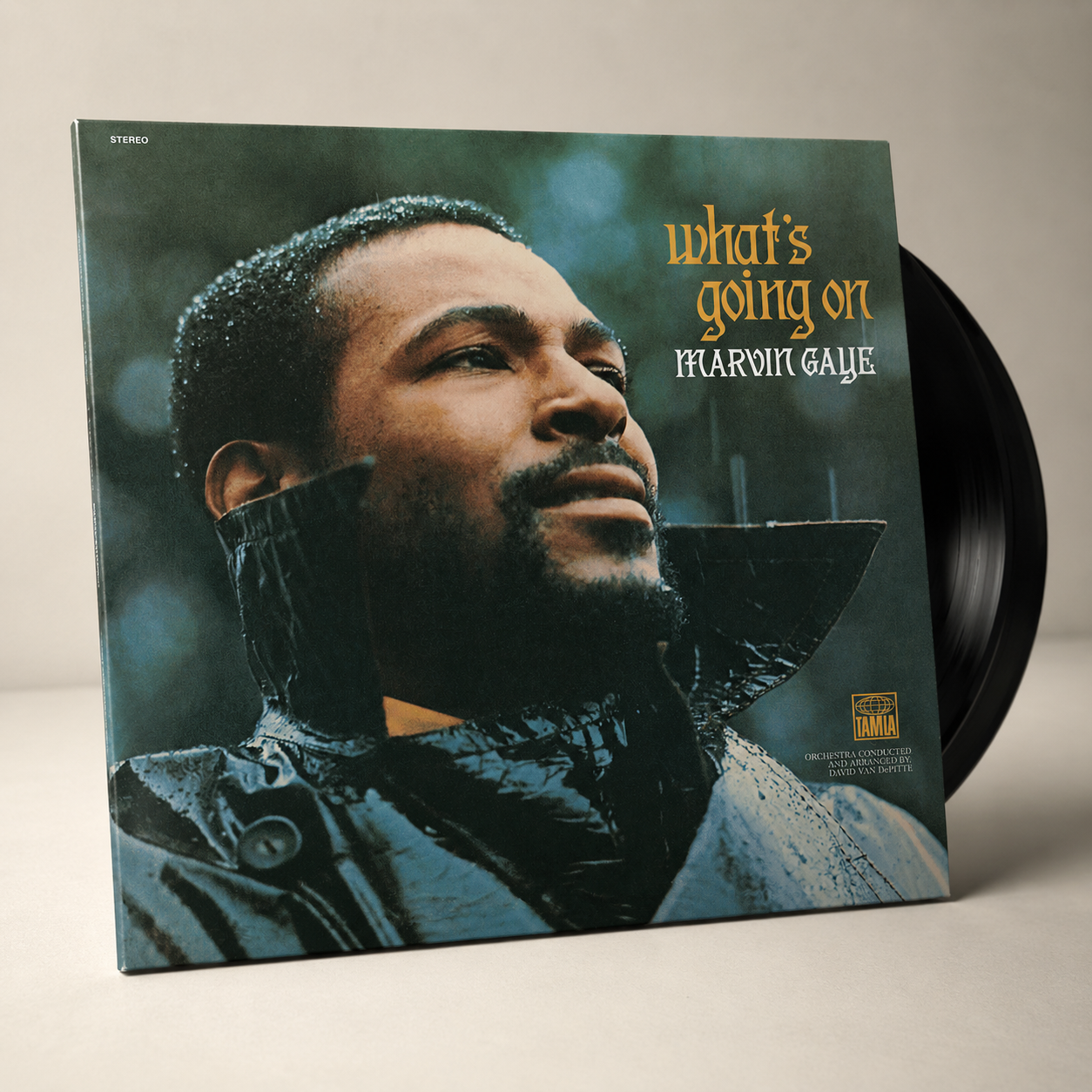
Dive deep into the historical, cultural and musical context of one of the most beautiful albums of the 20th century and discover why this album still stays relevant more than 50 years later. In this part we are analysing the reality and role of Marvin Gaye's life.
The reality and role of the artist
The influence of (subjectively) perceived reality has always influenced any kind of art. In the case of music, this can be seen both in the lyrics and in the music itself. The only constant in world history is change – regardless of time and culture. But is this really the case? What exactly distinguishes general, popular music (i.e. music that is widely distributed and listened to on a mass scale) from music that not only functions as a profit opportunity and promises a lucrative business, but also serves as a critique and personal “treatise” of the artist? In the 1960s, it became clear that African-American pop musicians in the USA were beginning to express themselves and make music more consciously and freely about the reality of African-Americans in the United States. Songs such as “Say It Loud – I'm Black and I'm Proud” – by James Brown (1969) or “A Change is Gonna Come” by Sam Cooke (1964) are signs of the hope, pride and suffering of African-American circumstances, which other African-American artists of the time also accepted with open arms. The culmination of the tension between African-Americans and Anglo-Americans obviously and logically had a great influence on the artists of that (but also our) time.
Marvin Gaye, as one of the biggest mainstream pop stars of the time, the figurehead of the “Motown” record company and its sound, also as a symbol of the sexual revolution, was obviously concerned with the current affairs of his fellow citizens and with his own fate and decided to sing about it. The question might arise as to why this was the case, as Gaye had no outward problems; he was financially secure, his music was extremely successful and consisted only of hits. One might think that he was content. However, Gaye was (naturally) preoccupied with the history of his people and towards the end of the 1960s he entered a depressive phase that affected his entire life – and his music. “What's Going On” not only cultivated a completely different musical, sonic aesthetic of the time – especially on “Motown Records” – but also had a completely new lyrical, emotional and creative concept, both for Gaye's opus itself and for his audience, for pop music itself, for the USA and, as this analysis aims to show, for world events at that time, but also today. It is precisely this synthesis that makes this “What's going on” a milestone in popular music.
1.1 The 1960s in the United States
In order to make this media analysis as clear as possible, a brief overview of the situation of racism and the general events of the 1960s in the United States should be provided. Considering the circumstances of the time – the assassination of the popular president J.F. Kennedy in 1963, growing protests against the government and its racism, the protests against the war in Vietnam, the civil rights movement and the famous political activity of civil rights activists Martin Luther King Jr. and Malcom X (and many others), the “Washington March” in 1963 (with over 200,000 participants, cf. WDL:1963) and in the context of overall social injustice – it becomes clear that African-Americans have had to take on one of the most difficult stories in world history.
But the peak of the tension culminated several years before the publication of Gaye's “What's Going On”. As mentioned above, these aspects had a great influence on the creative power of the artist, who now perceived music as a medium for communication and criticism of the problems. Gaye consciously used this album as a “filter” for his grief, but also as a medium for renewing and strengthening hope. The question he asks – “What's going on?” gets right to the heart of the confused, sad, unjust and chaotic society in which he and his fellow African-Americans lived. This is probably also the reason why “What's Going On” is considered the pinnacle of Gaye's musical creativity.
2. “What's Going On?”
When the album was released in 1971, nobody expected such work from Gaye and “Motown.”
In addition, the album is today (at least) considered a masterpiece of soul and popular music. The many professional accolades from music critics and the constant placement in the “top charts” of the 1970s (cf. RPM:1971) confirm the quality of this music and the concept for both music critics and the public. What is interesting, however, is what exactly made this album stand out so massively from the other music of the time and why it is still one of the most relevant works in music history.
2.1 Independence, lack of freedom - everywhere
The overall concept of “Tamla Records” (or “Motown”) was geared towards Gaye's creative power and musical virtuosity. In the 1960s, the record company achieved great fame – and Berry Gordy, as managing director and self-proclaimed producer, made a lot of money and success quickly. As the city of Detroit (and America as a whole) was experiencing rapid and diverse industrial development at this time, Gordy's company also attracted attention. He hired many employees, each with their own place and role: the “hits” were created by the talented, young, African-American musicians, Motown's “house band”, the famous “Funk Brothers”. This ensemble of incredibly talented musicians recorded the songs of all Motown artists and thus created the famous “Motown sound”. The formula for success was invented – young, talented, African-American artists making music that was attractive to both “black” and “white” audiences and could be marketed. Entire albums were often marketed and sold on the basis of 1 or 2 hit songs. To increase this profit, Gordy remained “politically correct,” which led to the same lack of freedom that many African Americans had to live through on a daily basis – segregation and injustice.
The tension grew not only in his business life, but also in his private life (cf. Gulla 2008:345), and Gaye used his music to channel his perception of the sad and bleak reality.
2.2 Chaos, suffering, hope and love
The first song on the album, “What's Going On”, creates a great connection with the listener in the first 20-30 seconds. Gaye achieves a lot in the first song musically, production-wise, politically and humanly. A brief imitation of a party can be heard at the beginning, which could be seen as a sign of a carefree life of his audience. There is no music playing. The listener is supposed to concentrate – or not. After just a few seconds, the whole concept opens up – sentences like “Be awake, people!”, “What's happening here?”, “Dream no more!” – then a saxophone solo and the band begins with many instruments and a new, percussive, previously unknown Motown style – but still deeply rooted in the African-American musical tradition. Finally, Gaye sings the opening verse (Verse 1).
With the “ingredients” of his music described above, Gaye not only achieves a strong connection with the listener but also makes a family out of his audience by creating an inviting, warm atmosphere. In light of current events, it could be said that such a personal, warm message was (and still is?) needed in society.
The message is clear. Before Gaye, no one had ever loudly criticized the interference of the states in the Vietnamese war – and above all, no one had ever done so directly. Moreover, such an open political statement was a complete novelty for someone from “Motown”. In comparison, Gaye's earlier albums, e.g. “I Heard It Through the Grapevine” (1968), “Easy” (1969) and “That's the Way Love Is” (1970) show no traces of sociocultural awareness. Gaye also took a slightly different musical path: The use of extended chords and “unusual” harmonic cadences, heavily influenced by jazz, present a “special” sonic synthesis for the ears of the public in this production. Classical orchestras and melodies, which are immediately audible and run through the whole album as a leitmotif, create a kind of coherence to the whole concept. Gaye uses the music as a symbol of unity and connection, in that the individual songs are musically very connected and flow seamlessly into one another. There are no interruptions, even if the songs have their own names and differ in subject matter. Marvin sets the atmosphere for the whole album with repetitive parallels to protests, war and racism. The ever-present and repetitive vocals in the background (often layered) create a metaphor of much-needed humanity through the color of the voices. In addition, the width and depth of the mix, which makes the vocals “big”, was an important step in the production – and was recorded using multi-track recording technology (cf. SOS:2011). The end of the title song is immediately followed by a new beginning.
As a commercial song on a commercial album, track number 2 “What's Happening Brother” is very unusual. The subject is very depressing and Gaye sets a melancholic, albeit musically virtuosic, tone when he wonders what is actually going on in the United States. He describes the situation of returning war veterans who are hit hard and confused by such unexpected chaos. Gaye also expresses his own depression here (Verse 4).
Furthermore, in the third track (“Flying high in the friendly sky”) Gaye sets a slower tempo and a degree “cooler” atmosphere, although the suffering remains. The musical virtuosity of bass player James Jamerson and Gaye's arrangement and production once again provide an ingenious metaphor. Gaye is “high in the sky” – is “high” on substances and has been briefly sedated – but the “restless” or incessantly playing notes of the bass could be interpreted as a corresponding contrast and a sign of deepest emotional unrest (the bass also has a low-frequency spectrum), which the text at the end of the first verse confirms. Through his experience with drug addiction, he describes the absurdity and pain of a drug addict.
In the next piece, Gaye makes an appeal to the population: “Save the Children”. In painful vocals, artful cries and a soft, almost tender instrumental, he shows the contrast between the lives of children and society then and now. The main theme of the entire album is the criticism of the socio-cultural circumstances of the time.
Up to this point, the song “God is Love” is the clearest sign of hope within the album. For Gaye, the solution is God and love, which he expresses clearly and loudly. For Gaye, God as the creator of this world and as the deepest experience of love – including love of neighbor – is the solution for all world events. The tenderness of his voice remains here, but overall he strikes a more positive tone (Verse 2, Bridge). The song flows into the next piece. The atmosphere changes very quickly, which is reinforced by harmonic modulation. The problems return.
Gaye's words are very clear in “Mercy Mercy Me (The Ecology)” (Verses 1-4). With this song, Gaye's criticism not only hits the political, economic, socio-cultural situation, but also ecological aspects of the world, which gives the whole thing even greater importance. Gaye is concerned about the environment. The vowels and the harmonic sequence at 2'13” again show feelings of helplessness and sadness, which can also be heard in the main voice. The world is despairing, bleak and sick. The change in the world is rapid and serves no one. The A-side of the original LP ends with this track.
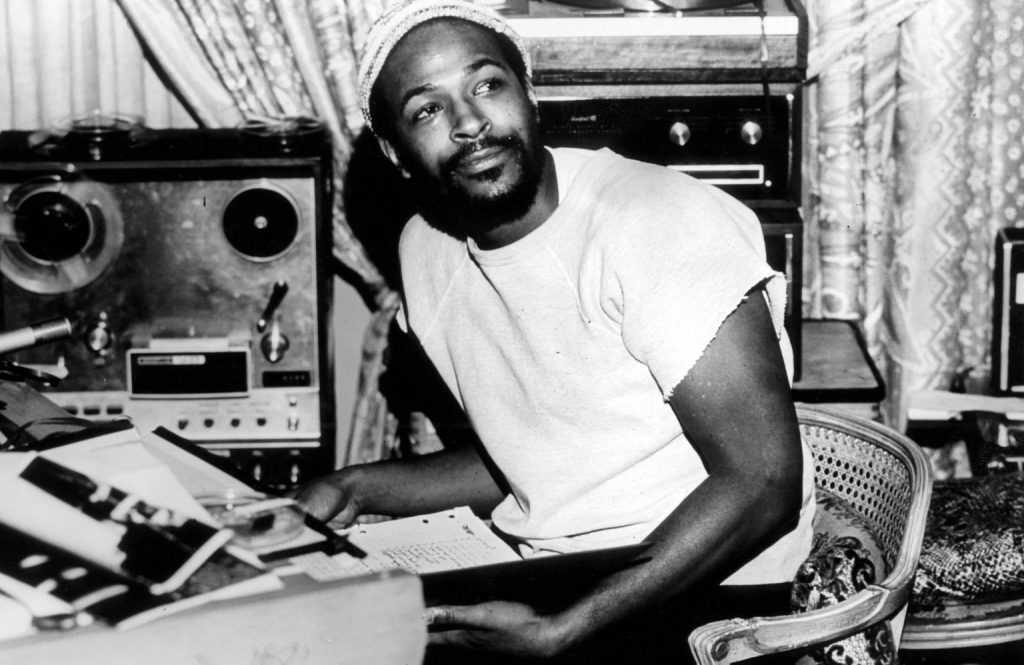
“Right On” sets a more relaxed atmosphere that can be compared to the “normal” music of the Motown record company. In this song, the general leitmotif of the album is expressed in a more relaxed manner. The instrumental, heavily infused with African-American rhythm, acts as a backdrop to the narrative of the issues Gaye has been dealing with (Verse 4).
“Wholy Holy” is the second and last spiritual or religious song. The hope of mankind should lie in the unity of mankind and faith. Here Gaye again shows his opinion on the solution to all problems: the answer comes from within or is deeply connected to the “soul”. However, Gaye's life is – as through album perceivable – full of contradictions. By seeking the solution, salvation or “redemption” for himself in drugs, it becomes clear to the viewer that Gaye was fighting an inner battle between physical and spiritual man, which only made him more interesting to the audience, as every human being has to fight such battles (even St. Paul writes about his inner struggles in the letter to Romans in Chapter 7). The contrast between an almost angelic voice, musical virtuosity, and a troubled personal life made Gaye the “Trouble Man” – until his tragic death when his own father shot him.
The album ends with “Inner City Blues”. Although the song is not a traditional blues due to its harmonic structure, Gaye sets a “bluesy” atmosphere here with criticism of the endless social injustice, criminality and illogic that he notices in the authorities. In the end, he accepts his and his fellow citizens' reality, which leads to Gaye just wanting to scream – “makes me wanna holler”. In the last minute, a retrospective of the beginning of the album takes place – Gaye returns to the beginning, musically to “What's going on”.
A reference to the beginning of the album and criticism of prejudices (not only racist, but now also prejudices about the ideas of the “hippie movement”, which was symbolized by long hair and was also marginalized and suppressed by society because it had an alternative view of world events – just like Gaye. This “return” to the first song rounds off the album in itself and creates a cohesive unit.
3. Conclusion - “What's going on” in world affairs today
In summary, the analysis has made it clear that the album “What's Going On” deals with many issues and has thus established itself as a tireless critique of current affairs and world events. Marvin Gaye has exposed and processed the problems of his reality in a special, strong, loud and clear way. He also offers his solution to the bleak circumstances: Profound, divine love for one another. With the production, arrangement and music, Gaye supports his thoughts, hints and criticism through many (genial) metaphors that form a synthesis and wholeness and also serve as a guide to the whole concept of unity, peace, hope, suffering, injustice, sorrow and love. Listening to and experiencing this album cannot leave anyone indifferent.
Exactly 53 years ago (1971), Marvin Gaye described on “What's Going On” an ecologically devastated world characterized by chaos, social injustice, general confusion, war, hostility. Half a century on, it's amazing how relevant the themes of this album still are today – more relevant than ever. Since its release, “What's Going On” has regularly featured on lists of the most influential albums (e.g. Rolling Stone Magazine) – and is still one of the most important works in music history, both musically and thematically.
Sources
Literature
- Gulla, Bob (2008). Icons of R&B and Soul: An Encyclopedia of the Artists Who Revolutionized Rhythm. ABC-CLIO.
- Hirshey, Gerri (1984). Nowhere to Run: The Story of Soul Music. Da Capo Press.
- Edmonds, Ben (2003). What's Going On? Marvin Gaye and the Last Days of the Motown Sound. Canongate U.S.
Internet sources
- Civil Rights March on Washington, D.C. (1963). Library of Congress — loc.gov/item/2021669757
- Aletti, Vince. What's Going On review, Rolling Stone — rollingstone.com
- RPM 100 Albums (21.08.1971) — collectionscanada.gc.ca
- Classic Tracks: Marvin Gaye, What's Going On — soundonsound.com
Pictures
- Marvin Gaye in studio — wbur.org